
Iron Brick AI Field Guide · Agents ·
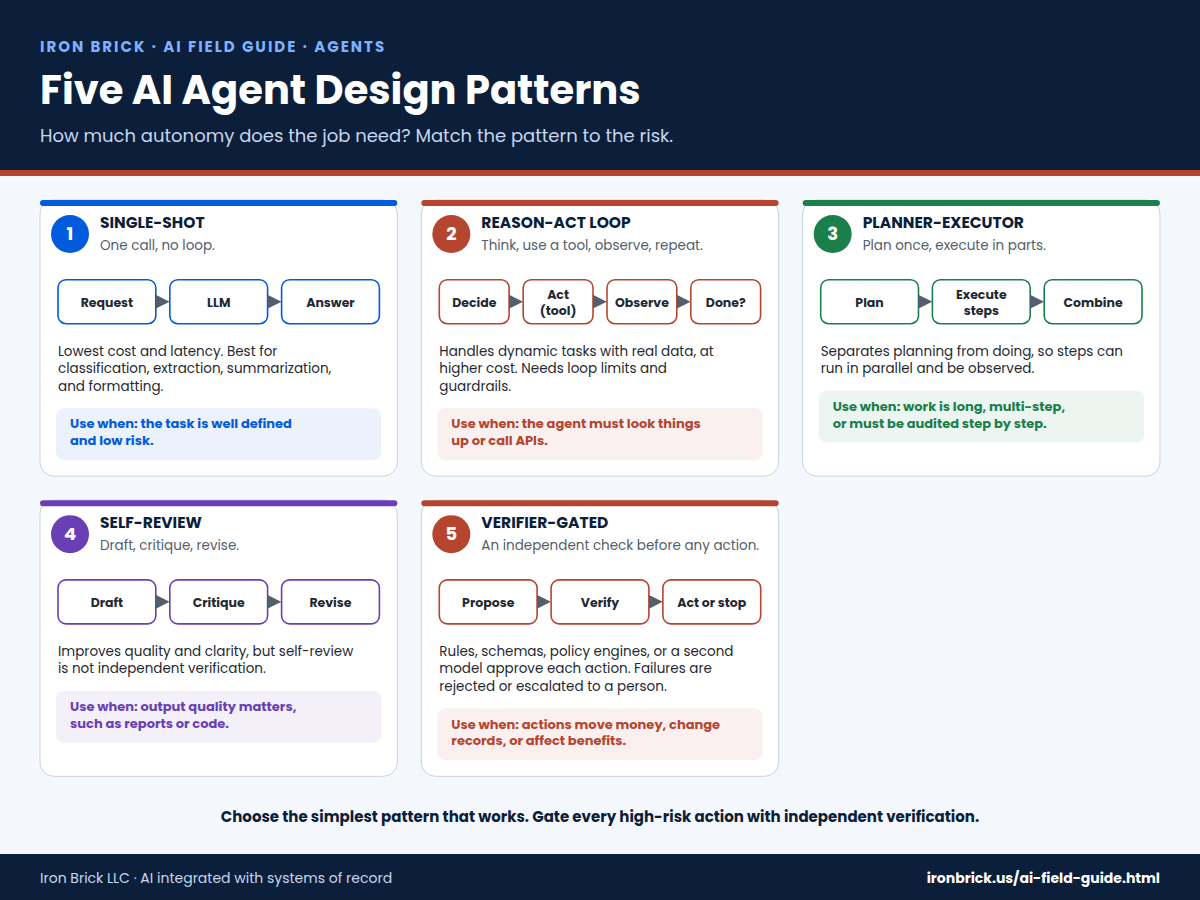
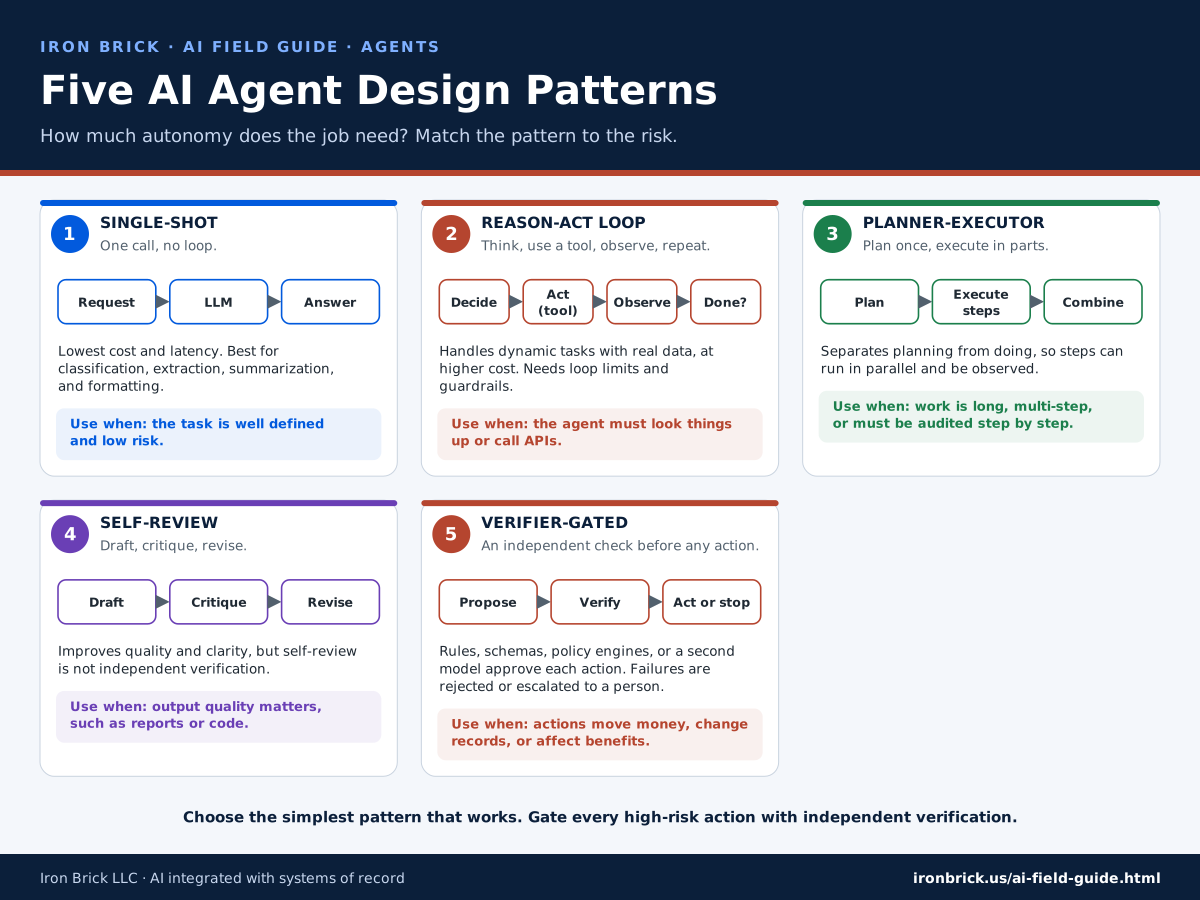
AI agents range from a single model call to multi-step planners that act on real systems. The right pattern depends on the task and on what happens if the agent is wrong.
Autonomy is a risk decision
Every step up in autonomy adds capability and adds ways to fail. A single-shot classifier cannot take an action; a reason-act agent can call any tool it is given. Choose the least autonomous pattern that does the job.
Combine patterns in production
Real systems mix them: a planner breaks down the request, executors use tools in reason-act loops, a self-review step polishes the output, and a verifier gates anything that changes data. Memory, observability, and guardrails (timeouts, retries, safety filters) wrap the whole flow.
Why verification matters most for agencies
For payments, eligibility decisions, and changes to records of record, the verifier must be independent of the agent: deterministic rules, schema validation, policy checks, or a human approver. Self-critique improves quality, but it is not a control. Every proposed and executed action should be logged with the user it acted for.
Key takeaways
- Match autonomy to risk; default to the least autonomous pattern.
- Give tool-using agents loop limits, timeouts, and narrow, least-privilege tools.
- Treat self-review as a quality step, not a safety control.
- Require independent verification and human approval for actions on money, benefits, or records.